
Teaching Plan
Materials:
Planting boxes
Soilless Mix
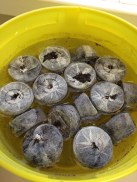
Peat Pellets
Trays
Measuring Cup
Watering Cans
Pail
Water (some warm water as well)
Craft Sticks & Permanent marker
Paper & Pencil
Preparation begins before school starts. I put together my materials. I have everything ready to go when the students arrive.
When we start, I gather the students at the back of the room and show them the equipment we use for garden set up. We talk about the soilless mix, the difference between it and garden soil, and plain old dirt. We go through all the elements that make up soilless mix.
Next, we measure water into the pail to soak our peat pellets. We use warm water, and not a lot is needed, depending on the number of pellets you are soaking, a cup or two should be enough. We record the amount of water we put into the pail and then we submerge the peat pellets. While they soak, we move on to our direct sowing crops.
Lettuce is a direct sowing crop. This means we sow the seeds right into the soilless mix. It’s usually the first one I plant with students. I put a large, empty planting box on the floor and open a bag of soilless mix. Enlisting the help of several students, we dump the soil into the earth box. Then everyone gets a chance to run their hands through the soil. It’s interesting because most children are amazed how soft it feels and what a pleasant sensation it is to run their fingers through it. There are always one or two who are reluctant and ask to go wash their hands right away, but I tell them we will be digging in the garden for a while and that we will wash our hands after we are done.
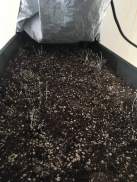
Once the box is filled and fairly level, I bring out the lettuce seeds. Lettuce is a great classroom crop because it grows quickly. You want this for some of the plants so that the children get fast results of their hard work. I sprinkle a few seeds into the first student’s hand and let them see those tiny little promises. They pass the seeds around, so everyone gets to see them, and the comments are always the same, but always good to hear. “They are so little!”, “Is this really going to be lettuce?” or some variation of these. When the seeds make their way to the front again, I select two volunteers – every student will get a chance to sow seeds during our planting – they make two long furrows in the soil and sprinkle in the lettuce seeds. Then I show them how to cover them up while I select two other students to fill the watering cans. When they come back with water, I show them how to gently water the garden, we push craft sticks with the name of the lettuce on them into the soil, we put the garden cover over the box of newly planted lettuce seeds, and that garden box gets put out of the way.
By now, our peat pellets have soaked enough. I bring the pellet tray down to the floor along with the pail of soaking peat pellets. I bring out the first set of seeds we are going to plant in the pellets – usually beans. I go through the same steps as with the lettuce, letting the students pass a seed around to feel it and see it up close. Remember some of the students may have never planted before.
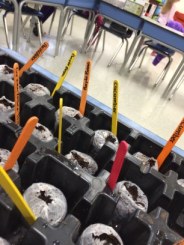
Then, each student gets to put two bean seeds into a peat pellet. They start by opening one end of the pellet just a bit, making a hole in the peat with their little finger, and then pushing the bean seeds in. Then we cover the seeds with the peat and place the pellet in the tray. Once again, we mark the plants so we will know what we are growing.
We repeat this with the other seeds we are planting in the peat pellets and then we measure the remaining water, recording the amount. Later, we will do the math to figure out how much of the water was soaked up by the peat pellets.
We put the dome on top of the pellet tray and put them near the garden light.
We then move on to planting peas. We direct sow peas the same as we do lettuce only instead of a furrow for the seeds, each pea seed gets put in its own hole.
By the time we are finished every student has had at least one opportunity to plant a seed. We clean up, wash our hands, and sit down to write in our garden journals.
 Teaching From the Garden